A student presenting a business pitch opens with three slides of product features and a price comparison chart. His panel listens politely. Nobody asks a follow-up question. The product may be sound. The presentation never answered the question the panel was actually asking: why does this matter to me?
The persuasive presentation is structurally different from every other type. Its job is not to inform, train, or inspire—it is to move an audience from a current position to a new one and make them want to act on it. Students who treat persuasive presentations as information delivery with a stronger conclusion miss that distinction entirely. The argument has to be built around the audience, not around the presenter’s enthusiasm for the topic.
What a Persuasive Presentation Is Designed to Do
Aristotle identified three modes of persuasion that remain accurate: ethos (credibility), pathos (emotional connection), and logos (logical argument). Effective persuasive presentations use all three. A presentation built entirely on data is a briefing. A presentation built entirely on emotion is a plea. The combination—credible presenter, emotionally resonant framing, logically sound argument—is what moves an audience.
The audience question that drives every persuasive presentation is “what’s in it for me?” Students who cannot answer that question for their specific audience before they build a single slide will not answer it during the presentation either. Audience analysis is not a preliminary step. It is the foundation the entire deck is built on.
The Architecture of a Persuasive Slide Deck
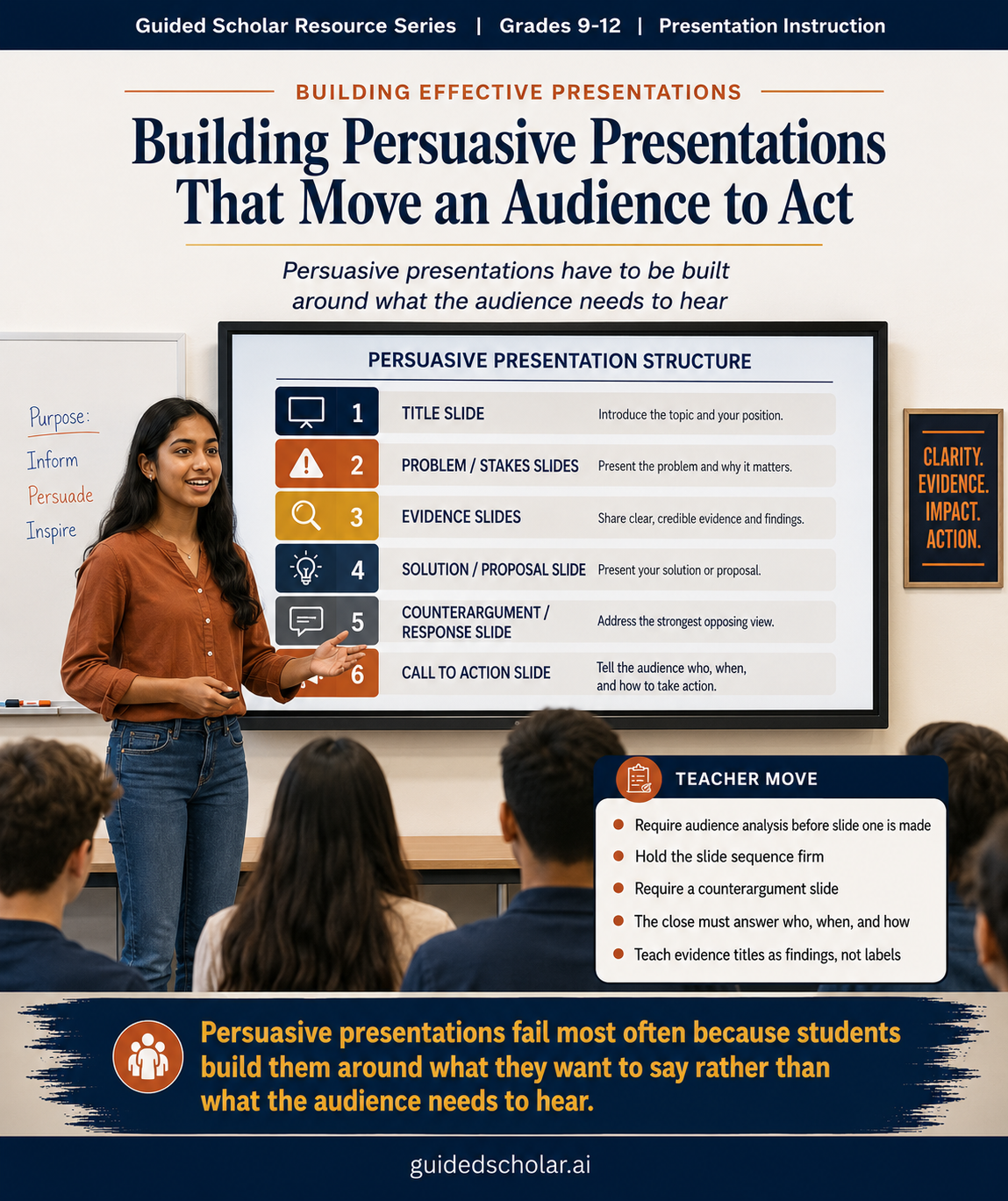
A persuasive presentation follows a problem-solution-call-to-action structure. The opening establishes the problem or need in terms the audience recognizes and cares about. The body presents the solution, the evidence that supports it, and the counterarguments it anticipates. The close names the specific action the presenter is asking the audience to take.
The sequence matters. An audience that does not feel the weight of the problem will not be moved by the solution. Students who open with their solution before establishing the problem are asking the audience to care about an answer to a question they have not yet been asked. Problem first. Solution second. Action third.
Building the Opening: The Problem Slide
The opening of a persuasive presentation has one job: make the audience feel the weight of the problem. Not explain it—feel it. The difference is the difference between a statistic and a story. “High school dropout rates cost the U.S. economy $90 billion annually” is a statistic. “A student who drops out of high school today will earn, on average, $400,000 less over her lifetime than a graduate” is the same data told in a way an audience can visualize.
The title slide of a persuasive presentation should name the problem, not the solution. The visual should make the problem concrete: a photograph, a chart showing a trend that demands attention, or an image that creates emotional engagement before the presenter speaks. Students instinctively open with their solution because they are excited about it. The audience needs to be concerned before they can be convinced.
Building the Body Slides: Evidence and Anticipating Objections
The body of a persuasive presentation carries three distinct slide types: evidence slides, counterargument slides, and solution slides. Most student presentations include only solution slides. The missing pieces are what prevent the argument from landing.
Evidence slides present data, research, or examples that establish the problem is real and that the proposed solution addresses it. Each evidence slide title should state the finding, not the data category. “Recidivism Data” is a label. “Rehabilitation programs reduce reoffending by 30% compared to incarceration alone” is a finding that builds the case.
Counterargument slides are the most commonly omitted element in student persuasive decks. Addressing the strongest objection to the proposal—before a skeptical audience member raises it—demonstrates credibility and closes the exit route. A slide that names the objection and then answers it directly is more persuasive than a deck that ignores the objection entirely.
Bullet Formatting in Persuasive Presentations
Bullets in a persuasive presentation carry a different burden than bullets in an informative one. They are not just conveying information—they are building a case. Each bullet should advance the argument, not add texture. A bullet that could be cut without weakening the claim is a bullet that should be cut.
Keep bullets short and specific. Vague claims (“This solution has been proven effective”) invite skepticism. Specific claims (“Pilot programs in three cities reduced costs by 22% in the first year”) build credibility. In a persuasive presentation, specificity is a persuasive tool, not just a formatting preference.
The Visual Layer: Making the Case Visible
Visuals in a persuasive presentation serve the argument. Every visual choice should be evaluated by one question: does this make the case stronger? Before-and-after photographs, trend charts showing a problem growing over time, comparison charts showing the proposed solution outperforming alternatives—these are persuasive visuals. Generic stock imagery that decorates without arguing is a wasted slide element.
Nancy Duarte’s research in Resonate (2010) identifies the most effective structure for persuasive presentations as a movement between “what is” and “what could be.” The visual layer should reinforce that contrast: images of the problem state paired with images or projections of the improved state. The gap between the two is what creates the emotional pressure that motivates action.
The Close: A Specific Ask
The most common failure in student persuasive presentations is a vague close. “I hope you’ll consider supporting this initiative” is not a call to action. It is an exit. A specific ask names what the presenter wants the audience to do, when, and how: “I’m asking the committee to approve a six-month pilot program at two schools, with a budget of $15,000, beginning in September.” The audience knows exactly what yes looks like.
The close slide should display the specific ask in writing, not just deliver it verbally. If the audience leaves the room and someone asks what the presenter wanted, they should be able to answer without guessing.
What This Looks Like in Guided Scholar
Guided Scholar’s Teach Me mode builds the persuasive presentation slide by slide. For each slide, the student writes the title, drafts the body text, and describes an initial visual he thinks fits the slide’s argument. Guided Scholar may suggest a different visual type if the one described does not match the content, or recommend a visual if the student’s slide has none. The student makes the final decision. He can submit for feedback at any point during the build, not only when the deck is complete.
The teacher’s dashboard shows the slide-by-slide progression, each feedback exchange, and subsequent revisions. A student who adds a counterargument slide after feedback has not just fixed a slide—he has demonstrated an understanding of how persuasive argument works. That revision is visible in the record.
Practical Starting Points for Teachers
- Require audience analysis before the first slide. Students answer three questions in writing: Who is my audience? What do they currently believe about this topic? What would it take to move them? Decks built without this foundation are built for the presenter, not the audience.
- Teach problem-solution-action as the non-negotiable sequence. Students who open with their solution before establishing the problem are making the most common structural error in persuasive presentations. Hold the sequence firm before any slides are built.
- Require a counterargument slide. Build it into the rubric. A persuasive presentation that does not engage the strongest objection to its argument is incomplete. Name the objection. Answer it.
- Evaluate the close for specificity. If the call to action does not name a specific action, a timeline, and a decision-maker, it is not a call to action. Require students to read their close slide aloud and ask: what exactly are you asking for?
- Teach evidence slide titles as findings, not labels. Give students five label-titles and require them to rewrite each as a specific finding that builds the argument.
The Through Line
Persuasive presentations fail most often because students build them around what they want to say rather than what the audience needs to hear. The argument has to be constructed from the audience’s position: what do they currently believe, what would change that belief, and what do they need to feel before they can be convinced to act.
Teaching students to build persuasive presentations with a problem-first structure, specific evidence, anticipated counterarguments, and a concrete ask produces a different result than assigning a topic and a slide count. It produces students who can construct an argument for a specific audience—which is what persuasive communication actually requires.
Aristotle, Rhetoric (350 BCE); Duarte, N., Resonate (Wiley, 2010); Reynolds, G., Presentation Zen (New Riders, 2008).